
1. A Maritime Makeover
For decades, Kerala’s 600-kilometer coastline has been framed by the “postcard-perfect” aesthetics of palm-fringed beaches and backwater tourism. However, following the May 2026 Assembly elections, the new administration under Chief Minister V.D. Satheesan is signaling a shift toward a “hard-hat” industrial future. With the launch of Mission Samudra, the state is attempting an ambitious maritime makeover that pivots from leisure to large-scale economic power.
This isn’t merely a policy update; it is an urgent, 5-year roadmap to fundamentally restructure the state’s fiscal identity. By integrating two international ports, 17 non-major ports, and an extensive network of inland waterways, the government aims to transform Kerala into a global maritime powerhouse. The scale of the vision suggests that the “blue economy” is no longer a peripheral sector but the new center of Kerala’s growth narrative.
2. Takeaway 1: The “Road-to-Sea” Revolution
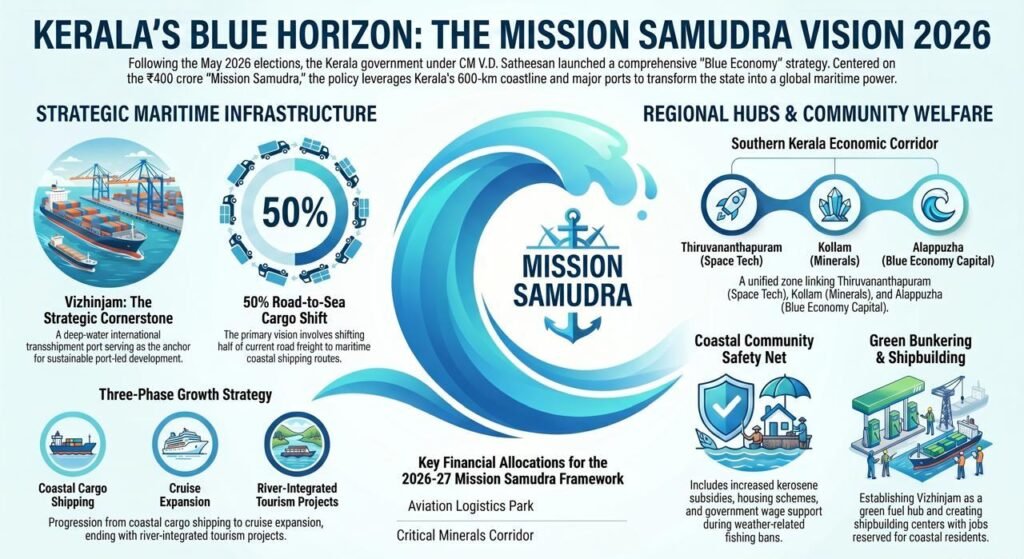
A central pillar of Mission Samudra is a radical shift in logistics: moving cargo transport from congested highways to the water. The policy sets an ambitious target of shifting 50 percent of all road cargo to sea routes. For a state like Kerala—characterized by high population density and narrow corridors—this “road-to-sea” transition is not just a green preference but a logistic necessity for industrial survival.
The strategy is intelligently phased to ensure scalable growth: starting with coastal cargo shipping, followed by an expansion into cruise shipping, and culminating in tourism projects integrated with the river network. By utilizing its 17 non-major ports and the existing container transshipment terminal, Kerala intends to lower the carbon footprint of its logistics while alleviating the gridlock on its land infrastructure.
“The government’s vision is to integrate these assets and transform the state into a major port-led economy, with at least 50 per cent of cargo currently transported by road eventually shifted to sea routes.”
3. Takeaway 2: Kerala’s “Dubai Ambition” and the Vizhinjam Anchor
The Vizhinjam International Seaport serves as the strategic cornerstone of this structural transformation. Capable of handling the world’s largest vessels, Vizhinjam is being positioned as a model for sustainable port development in South Asia. This vision is supported by the broader Port City project, which includes manufacturing zones and dry ports designed to maximize the port’s economic spillover.
Chief Minister Satheesan has explicitly benchmarked this vision against Dubai, where approximately 28% of GDP is derived from the port sector. To capture this high-value maritime trade, the budget designates Vizhinjam to become India’s primary green bunkering hub, focusing on sustainable refueling. This move aims to replicate Dubai’s success by shifting Kerala from a consumption-based economy to a production and logistics-led power.
4. Takeaway 3: A Tale of Three Districts (The Southern Kerala Economic Corridor)
To ensure geographical equity, the government has allocated ₹50 crore to establish the Southern Kerala Economic Corridor. This strategy links three southern districts, assigning each a specialized role that leverages existing local strengths.
Thiruvananthapuram: Positioned as a Knowledge and Space Technology Hub. By leveraging the presence of ISRO and VSSC, this hub will provide the satellite data necessary for oceanic mapping and smart shipping, making it the “brain” of the blue economy.
Kollam: Designated as the Rare Earth and Critical Minerals Processing Cluster, supported by a ₹100 crore mineral corridor allocation.
Alappuzha: India’s Blue Economy Capital
Under this framework, Alappuzha is designated as the national headquarters for fisheries and marine resources. It will serve as the administrative heart for coastal industries, overseeing sustainable extraction and processing of the state’s marine assets.
5. Takeaway 4: High-Tech Infrastructure Meets Hidden Innovation
The Mission Samudra budget reveals forward-looking infrastructure projects that prioritize intermodal connectivity. A standout proposal is the ₹200 crore Aviation Logistics Park, designed to link air and sea freight seamlessly. This is complemented by a proposed underground rail corridor to the Vizhinjam port, intended to facilitate high-volume cargo movement without disrupting the surface-level coastal environment.
Innovation also extends to the preservation of maritime identity through a ₹50 crore investment in an International Maritime Museum at Balaramapuram. This project reflects a dual commitment: providing modern industrial utility while showcasing Kerala’s shipbuilding traditions and coastal culture. It suggests that the state’s path to modernization is being built on the foundations of its historical maritime heritage.
6. Takeaway 5: The Friction of Progress (Welfare vs. Growth)
The transition toward a capital-intensive maritime model has created a delicate balancing act between industrialization and traditional labor sectors. Stakeholders, including the Kerala Matsya Thozhilali Aikya Vedi, have voiced concerns over a “pro-corporate” lean. They highlight that the Fisheries & Ports Department saw its allocation reduced from ₹239 crore in the LDF budget (January 2026) to ₹201 crore in the UDF revised budget—a significant ₹38 crore cut. Furthermore, as of late June 2026, no formal Government Orders (GOs) have been issued to operationalize these flagship programs.
To mitigate this friction, the government has introduced targeted welfare measures for traditional communities:
An increase in the kerosene subsidy to ₹75 per litre, covering 75% of the cost.
Government wage support for fishermen on days they cannot work due to weather warnings.
Employment reservations for coastal communities in new shipbuilding and maintenance hubs.
Provision of land titles for all coastal residents currently lacking them.
7. Conclusion: The Horizon of 2026
The transformation of Kerala into a maritime power is a 5-year journey that relies heavily on international partnerships. The Kerala–EU Blue Tides Conclave has already generated MoUs worth ₹7,288 crore from European investors, signaling global confidence in the Mission Samudra framework. By focusing on green ports and blue carbon initiatives, the administration argues that economic expansion is compatible with environmental stewardship.
“Protecting our oceans is not only an environmental responsibility but also an investment in humanity’s future and sustainable development.”
The success of this maritime pivot will ultimately be measured by its inclusivity. Can Kerala successfully modernize its economy and become a global logistics hub without leaving its traditional coastal communities behind? The answer will define the state’s economic landscape for the next generation.